‘Nuestra Herencia’: How a Chicago Schools Mariachi Group Landed a Latin Grammy Nomination

Mariachi

Mariachi Herencia de Mexico is comprised of students from Chicago’s immigrant barrios. (Meg Rachel / Courtesy Of Mariachi Youth Heritage)

A top-selling mariachi album landed a prestigious Latin Grammy nomination. Its main singers? They’re public school kids from Chicago.

The unlikely story started with an idea that came to Chicago resident César Maldonado.

Born in the Brighton Park area of the city, Maldonado’s parents were immigrants from Durango, Mexico. His parents were factory workers and did not know English. Maldonado excelled in school, and at 33, is a successful investment banker living in Chicago.

Maldonado wanted to give back, and he remembered that his elementary school never offered music or arts classes. He decided this is where he could make a difference for the next generation of young Mexican-Americans.

Maldonado did not have a music background, except for a deep appreciation for mariachi music — his parents played it constantly on the radio while he was growing up. So he decided to found the Mariachi Heritage Foundation (MHF) in 2013. Since then, the non-profit has grown to incorporate mariachi music education in the curriculum of eight of Chicago’s public schools, involving 2,100 students in grades 3 through 8.

As part of one of MHF’s programs, sixteen students, ages 11–to 18, were chosen, by audition, to take part in creating the group’s debut album, “Nuestra Herencia” (“Our Heritage”). After only about a year playing together, the group’s album was released this past May — and then it just took off.

“Nuestra Herencia” reached #2 Top Latin Album on iTunes– marking it one of the most successful mariachi album releases in history. It’s also believed to be the first major mariachi recordings released by a student ensemble in the U.S. It nabbed a Latin Grammy nomination in the “Best Ranchero/Mariachi Album” category.

“It’s beyond anything we thought to accomplish,” Maldonado told NBC Latino, adding that the group also recently played at the prestigious Kennedy Center to celebrate Mexican Independence Day with world-renowned musicians from both sides of the border. “These kids have a passion for the music.”

“Nuestra Herencia” was produced and arranged by Los Angeles mariachi master José Hernandez. It also features celebrated guest musicians from Mexico such as, Mariachi Vargas de Tecalitlán, and the top three Los Angeles ensembles, Los Camperos, Sol de México, and the all-female Reyna de Los Angeles recorded vocals on the album. The CD also includes tributes to Juan Gabriel and José Alfredo Jiménez.

“I tell people that mariachi is a sleeping giant in this country,” Hernandez said in a statement. “This album might open people’s eyes to what’s happening to mariachi education in this country. It’s really growing.”

 Mariachi Youth Heritage’s debut album was ranked No. 2 in its first week on iTunes’ Latin chart.  (Meg Rachel / Courtesy of Mariachi Herencia De Mexico)

According to the U.S. Census, Chicago’s Hispanic population grew by 17,000, from 2015 to 2016, and is now the second-largest ethnic group in the city (30 percent of the population). Maldonado hopes that through the integratiion of mariachi into the schools’ curriculums, it will help the students form a connection to their roots and thus increase their pride and self-esteem.

Maldonado said the idea for album came about in 2016, when the Latin Grammys, for the first time, suspended the mariachi genre for not having enough submissions.

“I always like to push the envelope,” Maldonado said. “Mariachi as a genre has been losing a following, because the big names have gone away or passed away —so you don’t really listen to it on the radio,” he said. “I decided to do an album with the students as a challenge for them.”

Maldonado hired the acclaimed José Hernandez and brought him to Chicago four times to work with the students.

“I was extremely proud with how much they learned and absorbed,” said Maldonado. “José really cares about mariachi education — he spends a lot of time traveling around the country educating in schools,” he said. “Mariachi is now in schools in Idaho, Wisconsin…It’s becoming a relevant music form which is engaging students.”

Maldonado is excited for the future, for both the genre and his band.

“We’re going to be touring on the weekends,” said Maldonado. “Next summer, we’re going to do a European tour, and our next album will be recorded in December, during Christmas break in LA, and it should be ready by the spring.”

Maldonado thinks mariachi is almost becoming more popular in the U.S. than in its native Mexico.

“Currently Mexico seems to favor banda, norteño, or American or European pop, and there hasn’t been a huge presence in promoting mariachi music,” explained Maldonado. “In the U.S., mariachi has been growing, because schools have committed to teaching it to its students.”

Originally published on NBCNews.com.

 

In Houston, Latino Volunteers Roll Up Their Sleeves to Help Hurricane Harvey Victims

BetoCardenas

Houston attorney and resident Beto Cardenas, and fellow volunteer, Karen Penner, have been helping out at Houston’s convention center. (Courtesy Beto Cardenas)

Hurricane Harvey has caused massive destruction and displacement, but it has also brought out the kindness and energy of volunteers like Beto Cárdenas.

A fifth-generation Texan born in Laredo, Cárdenas, 44, has lived in Houston for the past decade. As an attorney, he often does pro bono work and outreach for the Hispanic community; more than 40 percent of the residents in the nation’s fourth largest city are Latino.

This week, Cárdenas has been volunteering at the George R. Brown Convention Center as it houses thousands of people. “It’s about seven blocks from where I live. I happen to have friends from the UK — Manchester — visiting, and they’re helping too.”

The downtown area where Cárdenas lives is a little higher in elevation, so it wasn’t as affected in terms of flooding.

“My wife [Norma Bustamante Cárdenas] is a registered nurse and has been taking multiple shifts at Texas Medical Center, the largest hospital in Houston, making sure the staffing levels are intact, because people are having trouble getting out of their homes,” Cárdenas explained.

Registered nurse Norma Bustamante Cardenas is working extra shifts at Houston’s Texas Medical Center as her husband Beto Cardenas volunteers at the George W. Brown Convention Center. (Courtesy Beto Cardenas)


He said he’s been helping get medical supplies to the convention center and helping unload contributions — everything from diapers to clothing to board games.

“You see the force of nature, and that’s something that strikes you — then you see the force of the humanity, and you are obviously going to be moved by it,” Cárdenas said. “There is something to be said about Texas. It’s about rescue and recovery and looking out for each other —all the discussion about what could have been done better, that’s secondary.”

Cárdenas said there is a need for medical supplies such as sickness bags, urinals, bed pans, oximeters, gloves, masks, catheters, chucks, saline, saniwipes and bandages. Houston’s food banks are also collecting donations.

Marc Martinez, 51, is an Army veteran who retired in 2014 after serving 22 years. In 2012, he joined the non-profit Team Rubicon, which unites the skills of military veterans and first responders to form rapid response teams in emergency situations; Martinez volunteers there six to eight hours a week, while working at the Department of Defense in the U.S. Army full-time as a civilian conducting environmental health inspections in Fort Carson, Colorado – where he resides.

Team Rubicon is collecting donations for Harvey and lending a hand.

“They called me on Sunday evening,” said Martinez. “Luckily I have great bosses, and I was able to take a seven-day leave.”

He’s currently serving as the second in command in the disaster area as the deputy incident commander.

He is still in shock at the magnitude of the storm saying it is about three times more rain than Hurricane Katrina. He’s also grateful for the amount of volunteers at hand.

“The Cajun Navy showed up, and pretty much everyone with a boat showed up,” said Martinez. “The number of people helping complete strangers is outstanding. They dropped what they were doing and came to help. It’s nice to see people actually have a good side – especially after the incidents recently at Charlottesville.”

He said one of their biggest challenges have been the flooded roads, but the boat crews have successfully conducted over 41 rescues.

 A view from a rescue boat from Team Rubicon, where Marc Martinez is volunteering.  (Courtesy Team Rubicon)

According to Martinez, military veterans thrive in chaos.

“Most of us have been deployed multiple times, so sleeping two nights in a hammock I have no problem with,” Martinez said. “I’m used to not eating for multiple hours. Our brains are focused on the job at hand.”

What he has seen people in need of is diapers and formula. “Without diapers, it puts stress on the child and family members.”

Regina Garcia resides in Corpus Christi, where she was born and raised, and she suffered minimal damage to her home there. Hurricane Harvey started on Friday, the 25th, the day of her 46th birthday.

She is an employee at H-E-B Grocery Stores, a Texas supermarket chain, and has been spearheading a mobile kitchen effort serving free meals to hurricane victims since Tuesday evening.

 Volunteers from the H-E-B Grocery Stores, including Regina Garcia, working to get donated supplies to families in need.  (Courtesy Regina Garcia)

“Last night we served over 1,000 meals,” said Garcia on Wednesday, from where she and the rest of the team are currently based in Rockport. “We are using social media outlets to get the word out.”

She said they served 1,200 meals for breakfast, another 1,200 for lunch, and they were getting ready for dinner. They were giving away ice water and bread, and they setting up a pharmacy.

The area was still under strict curfew from 7 a.m. to 7 p.m. “We are here to help out as much as we can. Everyone’s worried about each other.”

Richard Garza was born and raised in Laredo and moved to Houston in 1986. For the past 11 years, he has been the director of Houston Gateway Schools — three open-enrollment charter schools serving 2,400 students. Affiliated with UnidosUS, the charter schools also provide a myriad of community services like ESL classes, immigration services, citizenship classes, and home buyer education classes. Ninety-eight percent of the students are Latino and 92 percent are low-income, at risk students.

“We have 200 employees, and 31 staff members were rescued,” said Garza on Wednesday. “Where the three schools are, it was all flooded within a 10-mile radius…I have not been able to go to the other two campuses because the streets are impassable…To put a dollar amount it’s quite a bit. Maybe $300,000 – including computers.”

The past few days he’s been making sure to keep in constant contact with his staff and families.

“I’ve been telling everyone to apply to FEMA — I tell them to do that first, then to follow up with their insurance and to let me know where they are short, so I can try to help,” said Garza, who was preparing to meet with the staff on Friday.

“I want to make sure we are going to be ready before Tuesday and make sure we have food for the kids,” he said. “I want to make sure our facilities are ready for breakfast lunch and dinner. The sooner I can help my staff return to work, the sooner the kids can have a normal day-to-day life.”

He’s also reaching out to extra counselors for his students, as he only has three on staff.

“If adults get stressed out and get anxiety attacks, I can only imagine how children feel,” said Garza. “On Tuesday, I want to hear from the kids and parents and see how I can help them.”

Pastor Hernán Castaño is the senior pastor of Ríos De Aceite Church, which is part of the U.S. Pastor Council. He has two Hispanic congregations — one in Houston, made up of 900 members, and one in Katy, made up of 150 members. He has served the local community as a pastor for more than 15 years, helping counsel individuals and families in everyday issues.

“We are already coordinating efforts to gather donations at our church building, cooking food for the homeless and hungry and distributing all donations to those that have lost everything,” said Castaño on Wednesday. “Working with other churches, we will give 100 percent of ourselves to save lives, help people, and rebuild this city.”

On Friday, Sept. 1st, the church is planning to open its doors from 9 a.m. to 5 p.m. to receive donations of clothing and shoes in good condition for both adults and children, baby wipes, baby formula and food, new blankets and pillows, water, nonperishable food, towels, deodorant, toothbrushes and toothpaste, razors and shaving cream.

The pastor said it was “noticeable” that amid political divisions and controversy, including the issue of the SB4 immigration law, “many Latinos are out there helping regardless of color, race, immigration status and background.”

Originally published on NBCNews.com.

‘La Bamba’ At 30: Director Luis Valdez, Esai Morales Talk About Film that Redefined Latino Roles

LuisValdez

Luis Valdez with Lou Diamond Phillips playing Ritchie Valens in “La Bamba.” (Courtesy Columbia Pictures)

The 1950’s in America: Families would gather around the television every night, and young people sang and danced to the rock and roll of Elvis Presley and Chuck Berry. For a short time, there was also a teen sensation from Pacoima, California, who made teen girls go wild.

His name was Ritchie Valens, and he was only 16 when his songs, “La Bamba” and “Donna” became Billboard hits. A year later, in 1959, his life came to an abrupt end in a plane crash, along with fellow rock stars Buddy Holly and the Big Bopper.

Few knew then that the singer’s real name was Richard Valenzuela and that he was Mexican American. At first, even award-winning Chicano writer and director Luis Valdez thought he was Italian, like other known singers of the time, Frank Sinatra and Dean Martin.

However, little did Valdez know then that in 1987 he’d be bringing the talented Valens back to life by writing the screenplay and directing the iconic film based on his short life. “La Bamba,” which made it to the top 5 in the box office on opening weekend and was nominated for a Golden Globe, turned 30 on July 24. In many ways, the movie redefined Latino roles in Hollywood and showed that a Latino teen who became a rock and roll star was as American as anyone else.

“It was significant, even more so then,” Valdez told NBC News, about the importance of a Chicano writer in the 1980s writing about a fellow Mexican American who became a music legend. “Latinos were traditionally cast as the villain roles, and I was able to tell the story of a rock and roll pioneer.”

Before entering the film industry, Valdez was already establishing himself as “the father of Chicano theater.” He won many accolades for his play about racism in 1940’s Los Angeles, “Zoot Suit,” and he founded El Teatro Campesino in 1965 in San Juan Bautista, California. Originally, it was meant as a cultural distraction for the tired, overworked farmworkers of Cesar Chavez’ United Farm Workers. However, it has since expanded to bring the arts to many communities, and all ages, for the past 50 years – ultimately earning him the prestigious Presidential Medal of Freedom in 2016.

“One of the first things about writing is, you write about what you know,” Valdez said. “Ritchie was born in 1941, and I was born a year before that. We traveled very similar paths. Once I got to know his family, and where he lived, and where he grew up, I could see vast similarities.”

In the summer of 1958, Valdez said he remembers seeing Valens at 16 working in the crops picking apricots.

“It was only a couple of miles from where I lived,” said Valdez, who also grew up as a farmworker. “All of that rang very true to me…He was a diamond in the rough. He was his own composer. He learned how to play guitar from his uncles…I think all Latinos acknowledged the fact that he verified our presence in the world with the same tastes and interests.”

When Valdez was in college, he said he remembers vividly going to parties with his friend who would play guitar, and Valdez would sing, “La Bamba,” a Mexican folk song later adapted for rock and roll by Valens. The same song would have a strong significance later in Valdez’ life as well.

Valdez’s inspiration to make the movie took place 1979, decades after Valens’ death. Valdez was now a respected playwright, and it was the opening night of “Zoot Suit” on Broadway. Valdez, the first Chicano director to have a play presented on Broadway, said he and his brother were looking out of the theater onto the street, discussing what the next project should be.

“We were sitting up there pretty full of ourselves,” Valdez said, laughing heartily at the memory. “We heard mariachi, all of a sudden, in the heart of New York City – on the street. They were playing outside of my brother’s dressing room. The mariachi was sent by the president of Mexico for our opening night.”

The song that happened to be playing was, “La Bamba.”

“My brother and I looked at each other and and said [in unison], ‘La Bamba!’,” recalled Valdez. “As a matter of fact, “La Bamba” became our obsession for the next five years.”

Valdez and his brother started making contacts and looking for the late Valens’ relatives, the Valenzuelas, in Los Angeles. They ended up finding Valens’ brother, Bob Morales, at a bar in their local San Juan Bautista, up north. Through Bob, they met Valens’ mother, sisters, extended family, and even his high school girlfriend and song’s namesake, Donna.

“I have to give the credit to Bob,” said Valdez, about the film’s authenticity.

“When I interviewed him, I told him to be honest,” recalled Valdez. “He said, ‘I was a drunk and a womanizer and all of that — just tell the truth.’ So I did.”

Valdez credits the long-lasting success of the film to the talent of the cast, which were mostly Latino and not well-known at the time.

Lou Diamond Phillips played Valens.

“He was very shy. But once on camera, he was right on,” remembered Valdez. “He was so sensitive, and the camera loved him – he couldn’t play the guitar, but he could lip sync. We put him on training for the guitar before we started the movie.”

Together with the late Elizabeth Peña, who played Bob’s girlfriend, and Rosanna DeSoto, who played Ritchie’s mom, Valdez is still pleased with his cast three decades later.

 Screenplay writer and director Luis Valdez. Columbia Pictures

Actor Esai Morales, who is now busy playing a lead role in the Netflix series, “Ozark,” and running for president of the SAG/AFTRA union, played Valens’ brother Bob, a memorable character whom he understood.

“I realized I had a lot more in common with Bob that resonated – I too grew up without the presence of my biological father, and I’ve always felt like an overlooked talent,” Morales said. “I think that explains a lot of the pain of Bob’s character — it’s always about Ritchie.”

“I view Bob and Ritchie as two parts of the same force,” said Morales. “I view Ritchie as the treble and the melody, and Bob as the bottom, the depths.”

Morales was only 23 when he scored the role of Bob. At the time, he knew it could be a very special project with a potential to be a classic. Three decades later, he is very proud of the movie’s significance.

“I feel honored and blessed to have been part of a truly representative and historic piece where we as Latinos are portrayed in a more complete light and manner that Hollywood usually affords us,” Morales said. “We are not the side dish, we are not the problem. We are the American dreamers embodied by Ritchie.”

The film’s two main actors, Phillips and Morales, are not Mexican American; Morales is Puerto Rican and from the Bronx, and Lou Diamond Phillips is of mixed – mostly Filipino – ancestry. But the struggles of life as a minority in America was a shared experience that transcended the actors’ different cultural origins.

“We were a real family. We were real close,” Morales recalled. “I owe a lot of my performance and what I was able to absorb from Bob – that Chicano pride nod — he gave me that. It’s something that I don’t think I’d be able to come up with on my own.”

Morales is still broken-hearted at the loss of his co-star Elizabeth Peña, who passed away three years ago, at the age 55.

“I still miss her,” said Morales, after an emotional pause. “She added another dimension. She gave the female energy of the film.” Peña and Morales were classmates in New York’s prestigious High School of Performing Arts, and he had a crush on her since he was 14; his role in “La Bamba” was a dream come true in more ways than one.

“I got to make out with her,” said Morales. “She had a way with words and was quick to laugh and make a joke. We just loved making each other laugh. I didn’t know we’d have such a short time with her.”

Morales wants to see more roles like these for Latinos in Hollywood, which is part of the reason he has thrown himself in the ring to be president of SAG/AFTRA, the union that represents actors, announcers and broadcast journalists, among others.

“We [Latinos] have so many good stories but so little support,” he said. “I think the time has come that our community demands to see more of who we are – so we can get to know each other better,” said Morales. “We tell certain stories over and over again, yet other stories are completely neglected, and I’d like to see a balance of the Latino American experience. We are also American and just as American as others. If you don’t know your history, you don’t know your value.”

For Valdez, it was a privilege to be able to tell this part of the Latino American experience which shaped an entire generation in the U.S.

“To take the 1950’s of my youth and turn it into a movie – the whole process of making art is it allows you to look at your life from the highest perspective.” said Valdez. “You’re able to see that you’re absolutely connected to everyone else. It helps you to deal with your past resentments, and I was able to look at my migrant farmworker life with affection…It’s backed up by a lot of heart. That’s what determines the success or failure of a film.”

Originally published on NBCNews.com.

Entrepreneur Creates a Bilingual Platform to Make Retirement Saving Easy

Within minutes of meeting financial entrepreneur Carlos García, you feel like you’ve known him for years, and suddenly, you’re discussing how to solve Americans’ lack of retirement savings.

“It is possible,” said the 37-year-old about one of America’s biggest challenges, “if you have the passion for it.”

This past February, García launched a startup aiming to do just that. Finhabits is a bilingual digital platform that gives investment advice and teaches and encourages individuals how to invest and save for retirement.

This, he explained, came from his realization that he grew up knowing very little about building wealth and saving, something he learned while working at his first job at Merrill Lynch in NYC.

“I never opened my 401K packet from H.R., and after three years, my colleague said, ‘I already have $30,000 saved for my retirement and the company matched it,’ and I said, ‘What?’ All these terms I didn’t know, and then I thought about all the people I know, and maybe their parents didn’t teach them either.”

García said that while his parents instilled in him an ethic of hard work, they were not familiar with long-term financial planning.

According to the Economic Policy Institute, this is indeed a common occurrence among Latinos. Only 26 percent of Hispanic families had retirement savings in 2013, compared to 41 percent of black families and 65 percent of white families.

“I got frustrated when I looked at my Merrill Lynch plan, but then I thought about the people who don’t work for a corporation and don’t have a pension,” said García. As fewer Americans work for big companies with 401Ks and pension plans, it’s even more imperative, say experts, that individuals know how to chart out their own savings.

Research by the National Institute on Retirement Security confirms that only 38 percent of Latinos, versus 62 percent of whites, have access to a retirement plan through their employer.

“Most people don’t contribute money to their retirement —what is going to happen when we reach 80? I thought to myself, “This is a Latino problem.”

García designed Finhabits as a platform that helps people who have never invested, develop the habit to do it. “If I can make saving for retirement more accessible and cheaper, it’s a winner — it’s just like going to the gym,” he said. “We text you to give you a nudge to contribute on a weekly basis.”

So far, Finhabits has been highly active in Texas, Florida and California. Most clients are new investors in their 30’s and saving for retirement using Roth IRA’s, contributing an average of $40 a week.

“We want to be in as many Hispanic-driven places as possible,” said García. “Any citizen or permanent resident can open an account. Eighty-five percent of our clients have never invested or had a retirement account before. Ninety-five percent of our users are mobile audience.”

What differentiates Finhabits from other digital financial apps, said García, is that it’s focused on long-term financial habits. The digital platform charges $1 per month for accounts under $2,500 and 0.5 percent per year for accounts that pass that amount.

“Many Latinos don’t retire and keep working, because they have to, but what happens if you get a health issue?” said García. “And there’s a difference between having a savings account and investing…Ideally, I want everyone to put 5 percent of their income away annually.”

García said that no matter how much one puts away, it’s best to just do it and not to put off saving.

García is no stranger to solving problems. He spent his formative years alternating between living in El Paso, Texas where he was born, and Juárez, Mexico, the birthplace of his parents —studying in both countries and speaking both languages. He left the U.S.-Mexico border when he got accepted into MIT, one of the world’s most prestigious universities —to study electrical engineering and computer science.

“I was an electrical engineer first, and electrical engineering teaches you how to solve problems,” said García. He later switched to a finance career in risk and asset management.

Though he has navigated in the high-stakes and lucrative world of finance, García sees his mission as helping support underserved communities, beginning with Latinos.

In 2010, after nearly a decade in Wall Street, García and a few friends from Mexico saw a need to help children affected by drug-related violence in Juarez. They formed Project Paz, a non-profit that partners with artists and socially-conscious brands to host fundraising events. The proceeds fund after-school art programs in Juarez. In the past seven years, more the 6,000 children have benefited from the program.

Apart from his philanthropic work, García is focused on helping propel what he thinks is a bright future for Hispanics.

“Latinos are the only group who has had income growth since 2008– so there is a huge potential that we are going to be the next wealthy class.”

However, García says saving money for retirement and building a nest egg has to be every individual’s own priority.

“It’s important that you take care of yourself, because the government is not and your employer is probably not,” said García. “If you spend an hour per year thinking about what you do with your money, you can double your wealth in retirement.”

Originally published on NBCNews.com.

A Stirring Tribute to Latin American Music Legends: Natalia Lafourcade’s ‘Musas’

Natalia Lafourcade (Courtesy Sony Music)

Physically, Mexican singer-songwriter Natalia Lafourcade is only 4 feet, 11 inches in height, but the soul she emanates with her ethereal music is fathomless. And audiences and critics agree – she won a Grammy last year for her album, “Hasta la Raiz,” in the Best Latin Rock, Urban or Alternative Album category – and this is in addition to the 8 Latin Grammys she has won.

In her newest album, “Musas” (“Muses”), she pays tribute to various musicians who have etched a musical memory in her heart at some point in her life and are beloved to many in Latin America and the U.S., such as, the late Chilean composer/songwriter Violeta Parra and Mexican dancer and actress Rocío Sagaón – well-known for appearing with actor Pedro Infante in the 1951 film, “Las Islas Marias.”

“I had many different teachers,” says Lafourcade. “I started writing songs at 14 about things I was living at school, and the things I felt at that age. In this album, I tried something different. I wanted to write about Veracruz, and my friend, Rocío Sagaón, who was like a grandmother to me and passed away two years ago. She was one of my inspirations.”

It was almost predestined that Lafourcade, 33, was to be a musician. She was born to two respected music educators in Mexico City, and spent a lot of her childhood in neighboring Coatepec, Veracruz amidst music and art. But the exact moment she herself was certain of her future, she remembers precisely.

“I knew that I wanted to be a singer when I was 10 years old,” Lafourcade tells NBC from Mexico City. “There was a party at school, and they invited me to sing for a play. I was really nervous, but when I was on the stage, I knew.”

And her feelings have never steered her wrong since. It is the profound way in which Lafourcade feels the experiences of life, which inspire her songs, that provide the magic touch to her compositions.

Her timeless, sweet and gentle sound is hard to fit in a specific box. She, herself, describes it as, “a mix of many genres. I would say maybe alt/pop, but now I’m trying to explore folk and traditional sounds of my country. Something that would include everyone.”

For the past decade, she says she’s been listening to a wide assortment of sounds, which cross countries, and genres, from Bob Dylan to Edith Piaf and La Lupe.

In her new album, she collaborates with the legendary Mexican guitar duo Los Macorinos.

“The idea to collaborate with Los Macorinos happened when we were having a concert as a tribute to Chavela Vargas four years ago,” said Lafourcade about Miguel Peña and Juan Carlos Allende, famous for accompanying the late legendary singer, Chavela Vargas. “That’s when I heard them on stage. I knew of them because of Chavela, but when I saw them on the stage, I thought it would be a great idea to work on a project with them.”

Last year, while on vacation in Brazil, the memory returned.

“When I got back to Mexico, I reached out to them,” says Lafourcade about how she got Los Macorinos to be her guitar and chorus accompaniment throughout the “Musas” album.

“It has given me so many things. It’s a very magical project. We decided to record the album live, and I never did that before,” she says. “I believe that’s why this album has this incredible spirit. Now I don’t want to record any other way.”

This all happened in a moment in her life that she needed music in a different way, “more ‘cotidiano’ (‘simple’ or ‘everyday’),” says Lafourcade. “I say that because working with Los Macorinos wasn’t as easy as I thought it was going to be. I would do everything faster. I had to go very deep, and I had to connect my heart and my soul in a very deep way – pay attention to the meaning of the songs and the energy. It made me more awake. That growth made me change the way I make my music now.”

She now adds Los Macorinos, who are in their 70’s, to her long list of teachers.

“It was very beautiful to share these moments. It was different for them, and for me,” says Lafourcade. “Before, I was working with artists who were my same age. Spending time with Los Macarinos was beautiful – to hear the music they were bringing to the table. There was a moment we had 200 songs we all loved, and we tried to decide which songs to include, so we were hanging out a lot and they told me a lot of stories.”

Her favorite musician to work with, however, she says was Cuban legend Omara Portuondo (from “Buena Vista Social Club”). They sing a duet on the track, “Tu me acostumbraste” (“I Got Used to You”).

“She is so amazing with powerful energy,” says Lafourcade of her 86-year-old mentor. “We get along very well.”

Although she’s going on a U.S. and Mexico tour, starting next month through October, Lafourcade says she will make a second volume of “Musas” later this year.

“I am 15 years into my career, and I want to go back to the piano and take the time to learn more,” she says. “I have many projects in mind like this one. By collaborating, you can do very interesting things. And it’s not just about me…We will see…”

For now, she just seems grateful for her experiences, and in love with life – as well as the person who inspired her original track, “Tú sí sabes quererme” (“You Know How to Love Me”).

“My mother always said I was singing before I was speaking,” laughs Lafourcade. “I came to this world to sing, and I feel very fortunate, because I am able to do that.”

Originally published on NBCNews.com.

Just Food Conference Brings Latinos to the Table on Food Activism

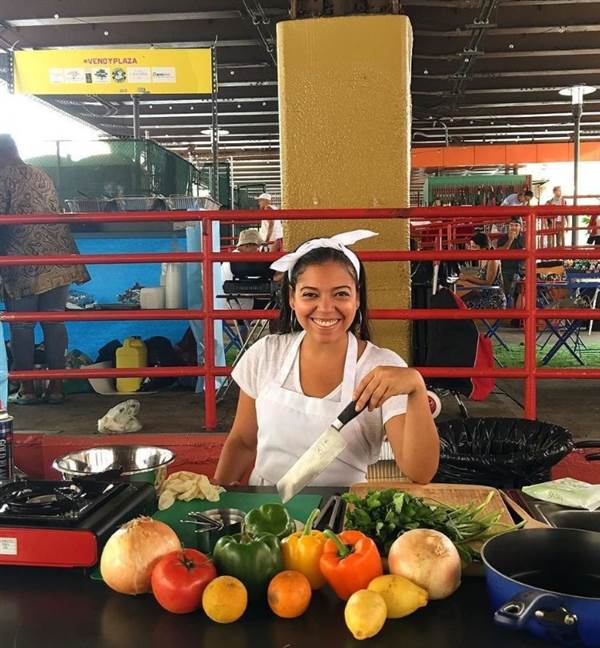
Yadira Garcia of Happy Healthy Latina conducting a cooking workshop in El Barrio, NYC in 2016 (Photo/Walter Roeder)

Yadira Garcia’s close relationship with food began when she fell down a flight of stairs in her junior year of college, leaving her unable to walk and in enduring pain.

The disability caused sudden spikes in her cholesterol and blood pressure, and she ended up with prescriptions for Oxycontin, Vextra and Lipitor. She said she suddenly had found herself, “a prisoner in her own body,” and at 20, was told this is what her life would be. Then she lost her health insurance.

“When you’re not handed the right road map, you can’t get to your destination,” Garcia said. “So, I went back to my elders. I thought, ‘What did my grandmother eat?’ I went finding these foods. I started to eat well and started to see how my health was improving and changed. I went from a walker to a cane. It was a three to four year process – very incremental. Eventually, I got off my cholesterol medication.”

Garcia told her story to open the 2017 Just Food Conference held this week at Columbia University’s Teacher College in New York City where nearly 800 food workers, farmers, scientists, activists and citizens gathered to collaborate on creating and advocating for an economically equitable, environmentally sustainable and healthy food system for all.

Now 33, Garcia is a food educator, community chef, and has her own blog, Happy. Healthy. Latina., where she posts her latest healthy recipes and answers readers’ questions. You can also check out her latest project there – a new cooking show, called “Healthy Cocina,” which is produced by actress Zoe Saldana, and also features Saldana’s sister Cisely.

Garcia, who was raised in New York City but whose family hails from the Dominican Republic, said our ancestral knowledge is our power. She decided she wanted to give away the knowledge she had, and she also put herself through culinary school – the Natural Gourmet Institute in New York.

“I learned how to activate Latino foods,” she said. “I make medicinal sofrito.”

In addition to hosting cooking workshops with seniors and ex-offenders in the community, teaching them how to use food in a healthy manner, Garcia is also on mission to get nutritional education to youth by spearheading wellness classes in schools.

“I am extremely concerned about H.R. 610 – the (proposed U.S. House) bill that will affect snacks and meals in schools,” said Garcia. “I feel an urgency now to tap the community … We train parents how to make demands. If we don’t know what’s happening, we’re silent. I talk with them to add their voice. We the people are the only ones who can make a change. We the people have to use our voice. Instead of being scared, we can talk … There is power in numbers.”

“I think this is why I was given my ability to walk again, to be able to share my testimony,” she adds.

While eating healthy foods is a challenge for some, for others, it is getting sufficient food at all, along with getting food that is nutritionally beneficial.

JoseChapa

Jose Chapa, farmworkers legislative campaign coordinator at Rural & Migrant Ministry at the 2017 Just Food Conference in NYC. (Photo/Kristina Puga)

Jose Chapa, 32, justice for farmworkers legislative campaign coordinator at Rural & Migrant Ministry, said food and restaurant workers are the most food insecure population – many can’t afford to feed themselves, and injury and illness rates at work are also high.

“Part of what I do is try to get the Farmworker Fair Labor Practices Act passed,” said Chapa, a panelist at the conference. “In the 1930’s, when the New Deal was passed, farmworkers were excluded from many rights like overtime pay, or a day of rest. The Farmworker Fair Labor Practices Act would enact a 40-hour work week and an option for a day of rest. A lot of the time, the standard of living is so low, there are no sanitary requirements, no protections for farmworkers. Only recently, they were given minimum wage and access to drinking water in the fields.”

Rural & Migrant Ministry, a non-profit located in Poughkeepsie, New York, aims to change unjust working conditions for farmworkers, and will be a part of the Cesar Chavez Rally for New York State Farmworker Rights on March 30.

Chapa, born in China, Nuevo León, Mexico, feels close to this cause, because he grew up as a migrant farmworker. He migrated with his family to the Rio Grande Valley of Texas when he was 4.

“My parents wanted a better education and future for me and my brother,” said Chapa, who came to New York three years ago to fight for farmworker rights, while the rest of his family is still in Texas. “Every summer, my family would go to Iowa and Minnesota to work the fields. My family worked picking corn and cotton every summer from when I was 4.”

He said he personally worked in the fields from age 15 through 16.

“I remember conversations of my dad talking to farmers in broken English. I heard racial epithets. That impacted me,” said Chapa. “The first time I went out in the fields to work, I had a heat stroke because it was so hot. Those two things drew me to this work.”

In addition to educating the community about the bill he wishes to see passed, he also reaches out to similar organizations to collaborate. He said he tries to create a sense of community where farmworkers can gather and talk about issues they are facing – especially with the increasing fear of immigration enforcement.

“I’ve heard of more activity of border control by Buffalo,” said Chapa. “We refer folks who are fearful to other organizations depending where they are in the state. What would help a lot is the passage of this bill. We have very good speakers on our side, and we are hoping these voices can give farmworkers a voice.”

RicardoSalvador

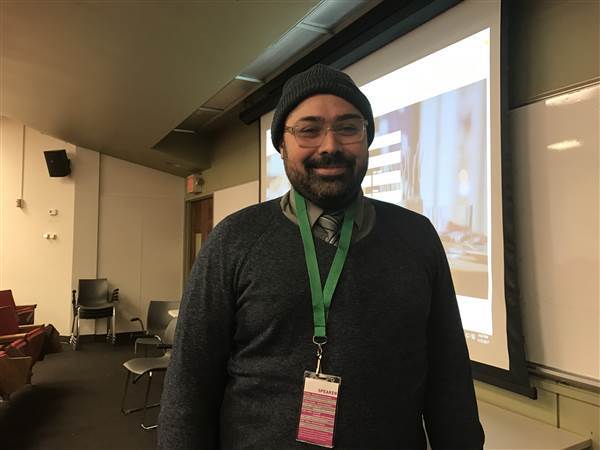
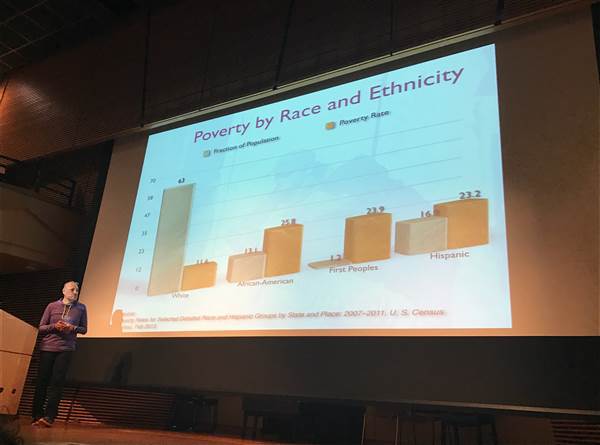
Ricardo Salvador uses chart to show how poverty intersects with race and ethnicity during keynote address at “The Future of Food Justice” session on March 13. (Photo/Kristina Puga)

Dr. Ricardo Salvador, senior scientist and director of the Food and Environment Program at the Union of Concerned Scientists, based in Washington, D.C., delivered the conference’s final keynote address, “The Future of Food Justice.”

“The footprint of inequity is something I want to talk about,” said Salvador, 59. “Without a just food system, we can’t have a just nation.”

He explains that a just food system is one that doesn’t exploit food workers, and the current model is based on production for as much profit as possible. The fundamental purpose of the food system, he said, should not be one which enables us to solely survive, but one which also nourishes us.

“Profits should not the primary goal, but healthy people and animals,” said Salvador. “But this is not feasible because most people are not informed. We need to point people to places where it’s working – that is concrete and real.”

One of the ways the Union of Concerned Scientists has taken action to coordinate and align leadership is by forming The HEAL Food Alliance. The national organization was founded in 2015 to bring together farmers, food service laborers, scientists, policy experts, and community activists in order to achieve effective policy change in our nation’s food system. It does this by empowering local leadership, training future politicians in policy issues and working against monopoly power structures.

This topic is close to Salvador’s heart, because like Chapa, he comes from a Mexican farm-working family. After the 1942 agreement between the U.S. and Mexico, also called the Bracero Program, his uncle and hundreds of thousands of mostly indigenous people migrated to join the agricultural labor force in various parts of the U.S.

“This set the pattern for decades of subsequent migration and exploitation,” Salvador writes in his blog.

“I have family farming in California and in Mexico, and they were all exploited,” he said. “I felt they were discriminated against – no matter how hard they worked. That’s why my work has turned into social justice work.”

Salvador’s research suggests that the U.S. has one of the highest rates of income inequity in the world. Other studies also have documented this.

“This is what needs to be undone…You deprive people of their land, and you will create impoverished people,” said Salvador, noting the income equity found in some Native American reservations. “There is an exploitation of human beings for the creation of wealth.”

Salvador continues to say, if we want a society where we all thrive, we need to invest in each other.

“If we are all one race, we really need to believe it,” he said. “All of us here now are making the future. We need to be careful not to commit the same errors … You have to believe things will get better, because you fight for them. I came from people who took big risks.”

Originally published on NBCNews.com.

‘Lucha Mexico’ Filmmaker Honors Lucha Libre’s Proud Tradition

DOC NYC 2015 Premiere Of "Lucha Mexico"Left to right: Filmmaker Alex Hammond, professional wrestlers Jose Luis Jair Soria, aka Shocker, and Jon “Strongman” Andersen, and filmmaker Ian Markiewicz attend the DOC NYC 2015 premiere of “Lucha Mexico” at SVA Theater on November 13, 2015 in New York City. (Photo/Monica Schipper / Getty Images)

For the longest time, documentary filmmaker Alex Hammond had wanted to work on a film which shed light on her Mexican heritage. The director of “Children of Haiti” and “Better Than Something,” which explored the punk underground, grew up in Connecticut but spent nearly every summer in Mexico visiting family; her mother had immigrated to the U.S. from San Luis Potosí.

The result is “Lucha Mexico,” her new film created with longtime co-director Ian Markiewicz, which explores the dynamic subculture of Lucha libre, the beloved and more than century-old Mexican professional wrestling sport.

After four years of shooting in mostly Mexico, “Lucha Mexico,” is being released in theaters and on iTunes on Friday, July 15, playing in cities across the country, including New York City, Los Angeles, Chicago, and Houston, among others.

Lucha libre literally means “free fight,” and dates back to the Franco-Mexican War in 1863. The wrestlers are known to wear colorful masks, which hide their true identities, and some are known for their aerial maneuvers. They also characterize themselves as “good guys” (called “técnicos”) vs. the “bad guys” (called “rudos”).

“I knew the moment I saw Lucha, that this is what I wanted to make a film about,” said Hammond, 35, to NBC Latino. “The idea that these athletes put themselves in the ring and put their lives on the line is where the interest started. When we got in there, we realized this world was so big.”

Hammond said it’s a good time to shine a spotlight on this sport, since it has been growing in popularity in the U.S. as well. Lucha Underground,” a weekly hour-long TV series which premiered in the U.S. on filmmaker Robert Rodriguez’ El Rey Network in 2014, is still going strong in 2016.

“Because it’s taken us five years to make the film from start to finish, we’ve seen lots of changes,” said Hammond about the growth of Lucha libre. “‘Lucha Underground’ is getting a lot attention now —you’re starting to find them happening more often, I think because WWE is so big. They helped introduce the Mexican wrestlers. More people are exposed to it.”

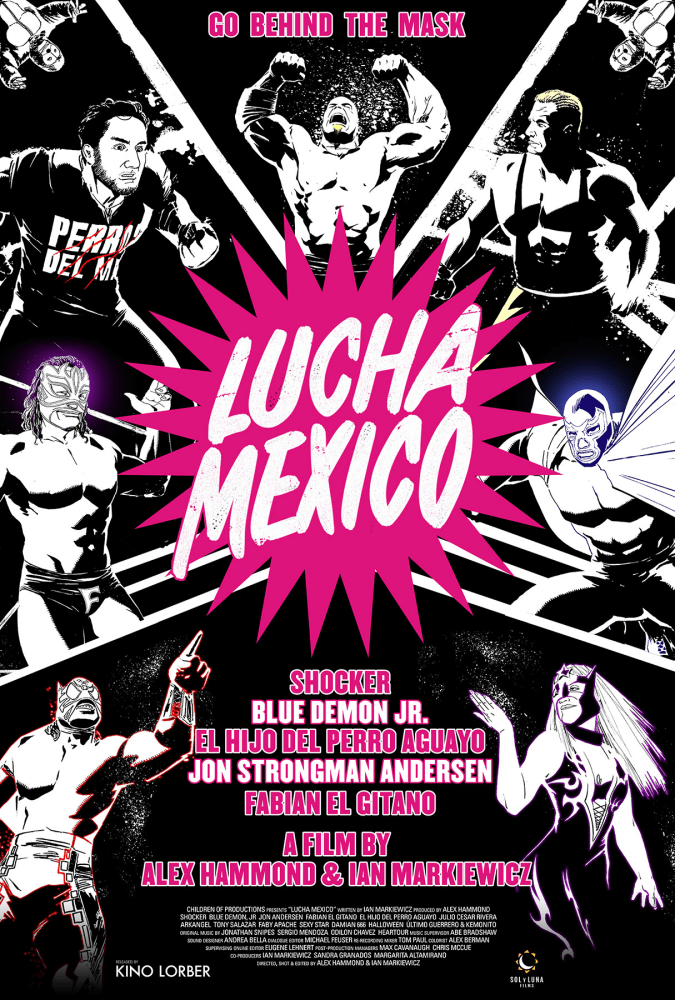
Film poster for "Lucha Mexico" by Alex Hammond.
Film poster for “Lucha Mexico” by Alex Hammond. (Courtesy Kino Lorber)

One of the film’s protagonists is American Lucha wrestler John Andersen, who goes by the wrestling name, “John Strongman.”

“He came down to Mexico from San Francisco as a pro-wrestler, and we got to document his first time going to Mexico,” says Hammond. “He would live in Mexico for a month at a time — now there are more Americans moving down there to wrestle.”

Hammond says the “luchadores” (wrestlers) are like superheroes for Mexicans.

“They are very real for the people,” says Hammond. “When you go to any show, you’ll see a grandmother and a baby – it’s a family affair.”

The “luchadores” themselves also take their careers very seriously. They go to Lucha school, starting sometimes as young as 15, to learn the proper fighting techniques.

Sexy Star (left), Faby Apache (right)
Sexy Star (left), Faby Apache (right) (Courtesy Kino Lorber)

“These men and women are really athletes, and you see how hard they work,” says Hammond. “For a lot of them, their parents were wrestlers…It’s like a whole close-knit family. When you retire, you work as a wrestling coach.”

The film shows how fans idolize their superheroes, but it’s not so glamorous for the wrestlers themselves. Blue Demon, Jr., the son of the legendary Blue Demon — who was also an actor in many movies, as his wrestling persona, in the 1960’s and 1970’s — describes the way of life as “lonely.”

“Out of 24 hours, I wear my mask for 18,” says Blue Demon, Jr. in the film. “You have to be a loner and not go out too much, eat cold meals in the hotel. You can’t go out at night, or you might be recognized.”

Photo of the late Perro Aguayo Jr.
Photo of the late Perro Aguayo Jr. (Courtesy Kino Lorber)

It’s also a dangerous sport. Hammond says the famous El Hijo de Perro Aguarro died in the ring last year.

“We had to recut the movie,” said Hammond, because he was supposed to be one of the main characters. “It was a freak accident. He died wrestling.”

Hammond said that throughout the making of the film, several wrestlers died from various causes.

But ultimately, the luchadores think it’s worth the risks and the sacrifices. One of the trainers told Hammond that ‘in order to be a wrestler, you have to be hungry and want to have that triumph.’

“That’s essentially what we wanted to capture,” she said, “what drives them to constantly get back in that ring.”

Hammond doesn’t know yet where her next project will bring her, but she says she’s always been interested in exploring different environments.

“I like getting people to feel like they are there,” she says. “For ‘Lucha Mexico,’ I wanted to show also how beautiful Mexico is – not just what you see in the news — it’s not just drugs.”

Originally published on NBCNews.com.

Ecuador Photographer Brings Food and Hope to Earthquake Victims

manuelaviles

Ever since Manuel Avilés was a teenager in his native Guayaquil, Ecuador, he was known in his high school as the one to help out whenever there was a need. By 17, he was committed to the idea of becoming a Catholic priest, but after volunteering one and a half years as a missionary in the Amazon rain forest and seeing how lonely the way of life can be, he opted to pursue another new found passion – photography.

Avilés had gone on his high school senior class trip to the Galápagos Islands with the new camera his aunt had gifted him. He immediately fell in love with capturing images of the lush landscapes of his beloved country. At 41, he is now a renowned professional photographer in Ecuador – spending his days touring the country for various projects.

Although many years have passed since his time as a missionary, Avilés’ innate desire to help people never left him. Ever since the devastating 7.8 magnitude Ecuador earthquake on April 16, which killed more than 650 and displaced nearly 73,000, he has devoted all of his waking hours traveling city to city along his country’s coast – from Manta to Portoviejo – bringing food, supplies and good cheer to the devastated people there.

Avilés says many of the victims are still sleeping outside where their houses once stood to take care of their belongings.

His photos, which you can find on his Facebook page, pretty much speak for themselves, and they have garnered supporters all the way from the U.S., such as this guy – Oakley Walker (featured below, left, with Avilés, right) who found out about Avilés’ cause and flew down from Florida to the small town of Canoa, Manabi to volunteer for three days.

Originally published on The Huffington Post – where you can see more photos.

Film Score Composer Carlos José Alvarez ‘Breathes Life’ Into Movies

Carlos José Alvarez (Photo: CJA Publicity)

Carlos José Alvarez (Photo: CJA Publicity)

The sweeping or exhilarating music you hear as you are watching a favorite scene is a big part of the magic of movies. This is what Carlos José Alvarez does, and at 36, he’s a prolific young composer in what is usually considered a more mature field.

Alvarez has already composed and arranged the scores for Hollywood films such as “Deadline,” “One for the Money,” the documentary “Cubamerican,” and contributed to the Oscar-winning “Still Alice.” He arranged and wrote the music for the Lionsgate thriller, “Exposed,” starring Keanu Reeves and Ana de Armas, which recently opened in theaters.

Alvarez, who has lived in Los Angeles for the past decade and now considers it home, says his career as a film score composer chose him. He also gives his two grandmothers credit.

“My mother’s mother was bed-ridden, and I used to watch films with her,” Alvarez says. “That’s where my fascination with films began. My father’s mother, who is still alive, is an incredible musician. She was a musical voice in our family.”

Alvarez was raised in West Palm Beach, Florida to a music-loving Cuban family. Sounds of classical scores, Cuban folkloric and Beatles tunes often emanated from his house. By 12 years old, he started playing the congas and the piano.

He explains he always knew he wanted to compose music for films, because he had always been in love with cinema, as well as music, and it was a perfect marriage of both of his passions.

“I was always into music, the story, the characters, the setting,” says Alvarez. “The music is there to tell us what’s happening when nothing is happening on the screen. It’s like the poetry behind it all for me.”

His most influential moment in confirming his career choice, he says, was meeting Michael Kamen – the composer for films such as, “Lethal Weapon,” “X-Men,” Die Hard” and “Mr. Holland’s Opus,” while Alvarez was in high school.

“One of the things he did was come to West Palm Beach to give a concert, and I heard about it and I wanted to be a part of it,” remembers Alvarez vividly. “I auditioned for the timpani part, and I got the job… It was such a big deal for me.”

After the concert, Alvarez says he went up to him afterwards, and said, ‘You know I’m going to be in LA one day doing what you’re doing?’ He looked at me and said, ‘I believe you.’ He really knew I meant what I said, and I think that was a turning point for me.”

So after excelling in his high school orchestra, Alvarez received a scholarship to attend Florida State University. Not knowing anything about writing music for films then, he would put up flyers all over campus offering to score student films for practice.

“I’d pull all-nighters trying to make it work,” says Alvarez, who upon graduating, was honored with a scholarship to the Berklee College of Music in Boston, where he graduated magna cum laude with a degree in film scoring.

Today, a typical day for him still involves up to 14 hours a day when working on a film.

“I cannot wait to be inspired, there’s no time for that,” says Alvarez, who works from a studio in his house. He was given six weeks to work on the score of “Exposed.” “I have to sit down and go. I have to shut out the world to get in the zone.”

Usually, Alvarez says his work starts when the film is at the end of the editing process.

“Once the film is close to being completed, I sit with the filmmaker and we go through the entire movie. We decide where the music should start, stop – there’s a lot of problem solving,” he explains.

Then, he begins writing the music by himself. He uses computer technology to create demos for the filmmakers to listen to, which ultimately are replaced by live musicians. Once the score is approved, then comes the recording process, and getting the sheet music ready for the musicians. Once it is recorded, it is time to edit the music, mix it then deliver it.

“‘Exposed’ takes place in Washington Heights [in NYC], which is very Dominican world,” says Alvarez about his latest film project, which he adds, has a large amount of Spanish in the script. “They wanted someone to be sensitive to that…Isabel [the main character who is of ambiguous Hispanic ethnicity] is surrounded by crime and corruption, and the score needed to pull us in there. The music that pulls us into Isabel’s world had to have mystery and playful innocence.”

He says he had this idea of using a female voice, so he sought out the Cuban-American award-winning Broadway star from “In the Heights” – Janet Dacal – for her very strong vocals, and gave her a scene.

“It was the most exciting part, because I knew I had found the heart of the score through her voice,” says the composer. “We really explored the mysterious, almost haunting, side of her voice. It really pulled us into Isabel’s reality and perspective…When I played it for everyone, we all thought this is it.”

Through the orchestral score, which was made up of 34 string players and piano, Alvarez says the main challenge was to connect the two worlds of Isabel and Keanu Reeve’s character, and express to the audience what the characters are feeling and experiencing.

“That’s what so magical about this job,” says Alvarez. “I wake up everyday hoping to create great music. I feel like I’m the first person that hears the film really come to life. If I do my job correctly, I’m breathing life into the film.”

(You can listen to compositions from Carlos José Alvarez here on his website.)

Originally published on NBCNews.com.
The Lives of Migrant Farmerworkers’ Children Focus of ‘East of Salinas’

https://www.youtube.com/watch?v=10nkxL1Hy50

When we think about where our food comes from, we don’t often think about what our farm workers go through on a daily basis, let alone their children.

Award-winning filmmaker Laura Pacheco thought about it for the first time after reading a New York Times article in 2011. The story was about Oscar Ramos, a third grade teacher in Salinas, California, who came from a migrant family. Ramos teaches in Sherwood Elementary School, where half of his class is made up of children of migrant farmworker families. Often these children have to move several times a year to follow the harvest and have to wake up at 3am to go to a babysitter, before school, so their parents can go work in the fields.

“I couldn’t stop thinking about it,” said Pacheco. “He knows what’s missing in these kids’ lives,” said Pacheco about Ramos.

There are more than 2 million farmworkers in the U.S., and their median wage is a little over $9 an hour. Immigrant farmworkers (approximately 75 percent are coming from Mexico) often leave their home countries to seek a better life for their families. However, the average migrant child may attend as many as three different schools in one year, often making it difficult for a child to advance to the next grade level.

'East of Salinas' producer/director Laura Pacheco  (Courtesy ITVS)

‘East of Salinas’ producer/director Laura Pacheco (Courtesy ITVS)

Pacheco was so intrigued by these figures that she wrote Mr. Ramos and told him she’d like to meet and talk to him about making a film. Together with co-director Jackie Mow, they decided to focus on one family, and one boy in particular, José Anzaldo.

“We decided to follow one to get an intimate look of what a migrant family is like in America,” says Pacheco.

After three years of filming, their film, “East of Salinas” will be premiering on PBS’ Independent Lens on Monday, December 28th. (10pET, see PBS for local listings).

Jose’s mother, Maria, is from Mexicali. She used to work in a clothing factory, but she couldn’t support herself and her children. Jose’s stepfather is from El Salvador, where he also did agricultural work, but he says, “You can live there, but you were always hungry.”

Coming to the U.S., the family still often goes to bed hungry, but not as much. José loves school, especially math, but he is one of two million undocumented children living in the U.S. today. He is María’s only son who was not born in the U.S. – so she worries about his undocumented status and what that portends for his future.

Pacheco and Mow were able to follow José around since the 3rd grade. He’s already attended more than five schools and is now in 7th grade. He’s continuing to do really well in school, said Pacheco.

“In the beginning, he’s a little naive about his situation, and at the end he becomes more aware,” said Pacheco. “It’s really hard to see someone’s potential, and then leave and not know if he’s going to have food the next day – Oscar (his teacher) still goes to see them and takes the boys to the movies.”

Teacher Oscar Ramos takes 5th and 6th graders, including José Anzaldo, to visit UC Berkeley, part of the 'East of Salinas' documentary.  (Courtesy ITVS)

Teacher Oscar Ramos takes 5th and 6th graders, including José Anzaldo, to visit UC Berkeley, part of the ‘East of Salinas’ documentary. (Courtesy ITVS)

His teacher Oscar Ramos sees the little boy’s promise and wants to help him get ahead. The question is, what opportunities will be available for children like José, a bright student who is undocumented?

Pacheco hopes viewers take away certain things from watching the film such as what education is like for farmworker children and where our food is coming from.

“But if I had to say one thing, I hope José lives in people’s hearts,” says Pacheco. “Immigration is a hot topic right now. It gets so polarized. People feel so righteous on both sides of the debate, but you can see who the kids are that are going to make America great and should be given an opportunity.”

“These are the families who are picking food for America,” says Pacheco. “We should know what their lives are like.”

Originally published on NBCNews.com.